True Liquidity [Fund Grade]


True Liquidity [Plazo Sullivan Roche Capital]
What it is
True Liquidity maps where real business keeps happening (volume shelves / POC / value area), then waits for the institutional sequence:Liquidity sweep → confirmation → reclaim → continuation, filtered by session, regime, HTF bias, CVD, and AVWAP.
This AI is the light version of our private Order Flow Ultra.
Download Free: True Liquidity Fund Grade
For the fully automated systems based on cTrader NinjaTrader or our prop system email us- there is a cost involved.
Once this is on your chart, you will never listen to self-proclaimed ICT or Crypto gurus who pump their bags at your expense.
Core logic (how signals happen)
1) Liquidity map (your “battlefield”)
Builds a local volume profile over your lookback.
Extracts:
POC (fairest price / most traded)
VAH/VAL (value area boundaries)
Liquidity shelves = high-activity price bands (thick lines)
2) Execution engine (the “trap and spring”)
A BUY setup requires:
Price is near a shelf
A sell-side sweep (wick below / stop raid) that fails
Displacement candle (impulse) + reclaim above shelf
Optional: MSS confirmation
A SELL is the mirror.
3) Anti-FOMO confirmation (entry hygiene)
Instead of chasing the impulse:
Marks a setup as pending
Waits for pullback/tag near shelf
Requires continuation candle closing beyond shelf
This dramatically reduces “I bought the top of the candle” entries.
4) Break & Hold continuation (trend-friendly)
Separate signal type:
Break through a shelf with displacement
Retest shelf
Hold (close beyond buffer) + continuation
This catches “institutional acceptance” moves.

You won't get many signals- but you get signals like this with visualization of the institutional volume shelves that triggered the signal.


Why it’s fund-grade
This is “fund-grade” because it behaves like a risk desk, not a signal spammer:
Context first, execution second
You’re trading around liquidity shelves, not random indicators.
Regime filter (ER)
Avoids chop where stops get farmed.
Event bar cooldown
Reduces entries during “news-like” volatility bursts.
Session intelligence
Aligns with where liquidity actually hits (London + NY).
HTF bias filter
Stops you from fading higher-timeframe flows.
CVD layer + divergence
Confirms participation / absorption vs. “empty” moves.
HTF Anchored VWAP + bands
Institutional mean / trend anchor to prevent trading against acceptance.
Scoring gate
Forces confluence: shelf strength + proximity + session + bias + delta + regime.
Result: fewer trades, higher quality, better drawdown behavior.

Protections checklist (what blocks trades)
If you’re not getting trades, the HUD “Why blocked” tells you exactly what’s stopping it:
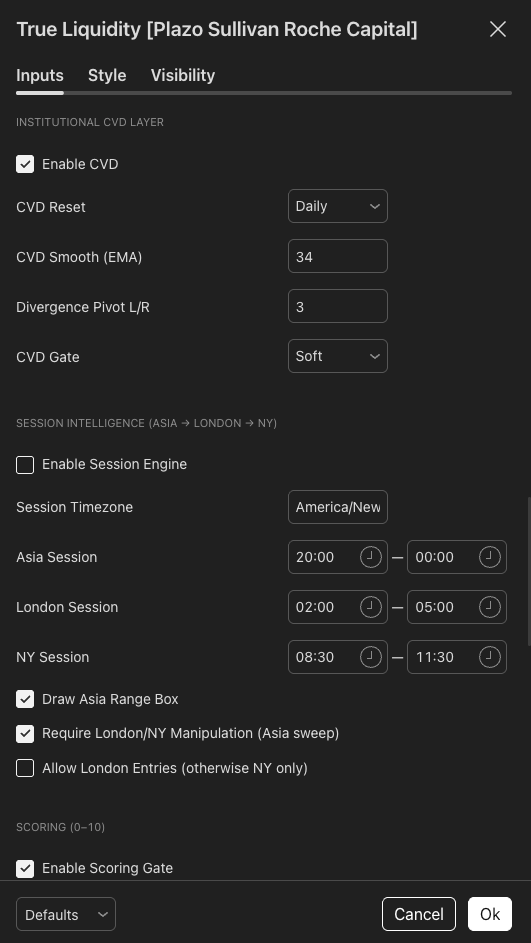
Signals OFF
Chop (ER) / Event cooldown
Outside LDN/NY or Not NY (if NY-only mode)
No Asia Manip (if required)
AVWAP gate
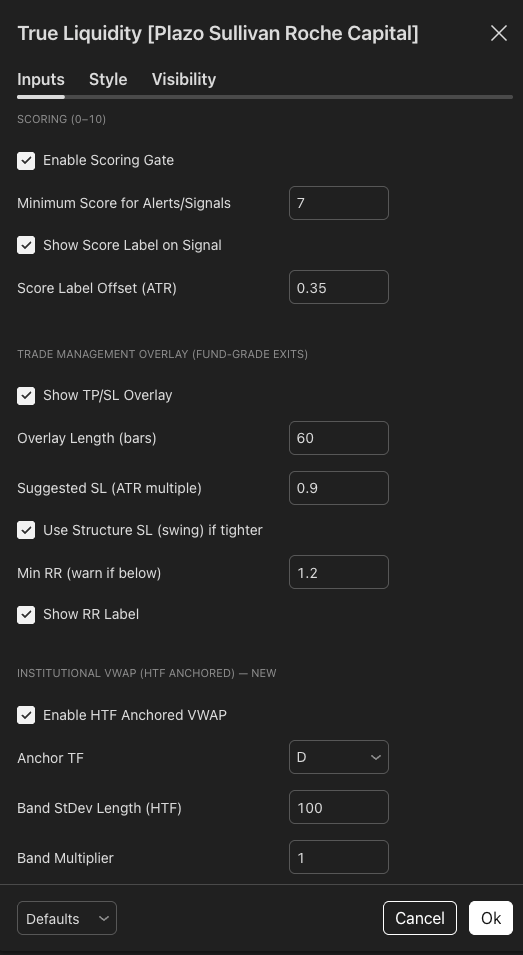
Score gate
Anti-FOMO pending
This is intentional: it’s a safety system.
Best practices (how pros use it)
Setup routine
Pick Mode:
Intraday (London+NY) for most traders
Scalp (NY Only) if you want fewer, cleaner trades
Swing if you’re trading around HTF bias and AVWAP
Let shelves “print” (don’t judge it in the first few bars).
Only act on signals near a shelf (that’s where stops and fills cluster).
Execution rules
Prefer signals that occur:
at strong shelves (thicker / more intense)
with CVD confirmation or divergence
aligned with HTF bias + AVWAP trend mode
If Anti-FOMO is ON: treat “pending” as good news, not delay.
Use the overlay:
SL should sit beyond the raid/swing
First profit is usually POC, then VAH/VAL, then next shelf
Risk management (non-negotiable)
Risk 0.25%–1% per trade.
If RR is flagged weak (RR label), either:
skip it, or
take partials faster (POC) and trail.
Best timeframe
Sweet spot: 5m and 15m (especially for XAUUSD + indices).
1–3m: more noise, needs stricter settings.
30m–1h: fewer signals but strong structure.
Swing mode: 1h–4h with HTF bias ON.
Best assets
Where this shines (deep liquidity + clean raids):
XAUUSD
US100 / NAS100, US30, SPX/US500
EURUSD, GBPUSD
BTC, ETH (best around NY session; keep event filter on)
Avoid / be cautious:
thin minors/exotics (spread + manipulation distort shelves)
dead sessions on indices
Recommended defaults (practical)
Mode: Intraday (London+NY)
Scoring gate: ON (min 7)
Event filter: ON (cooldown 5–6)
Regime filter: ON
CVD: ON (Soft)
AVWAP gate: Trend
Anti-FOMO: ON
Break & Hold: ON


Comments